%201.svg)
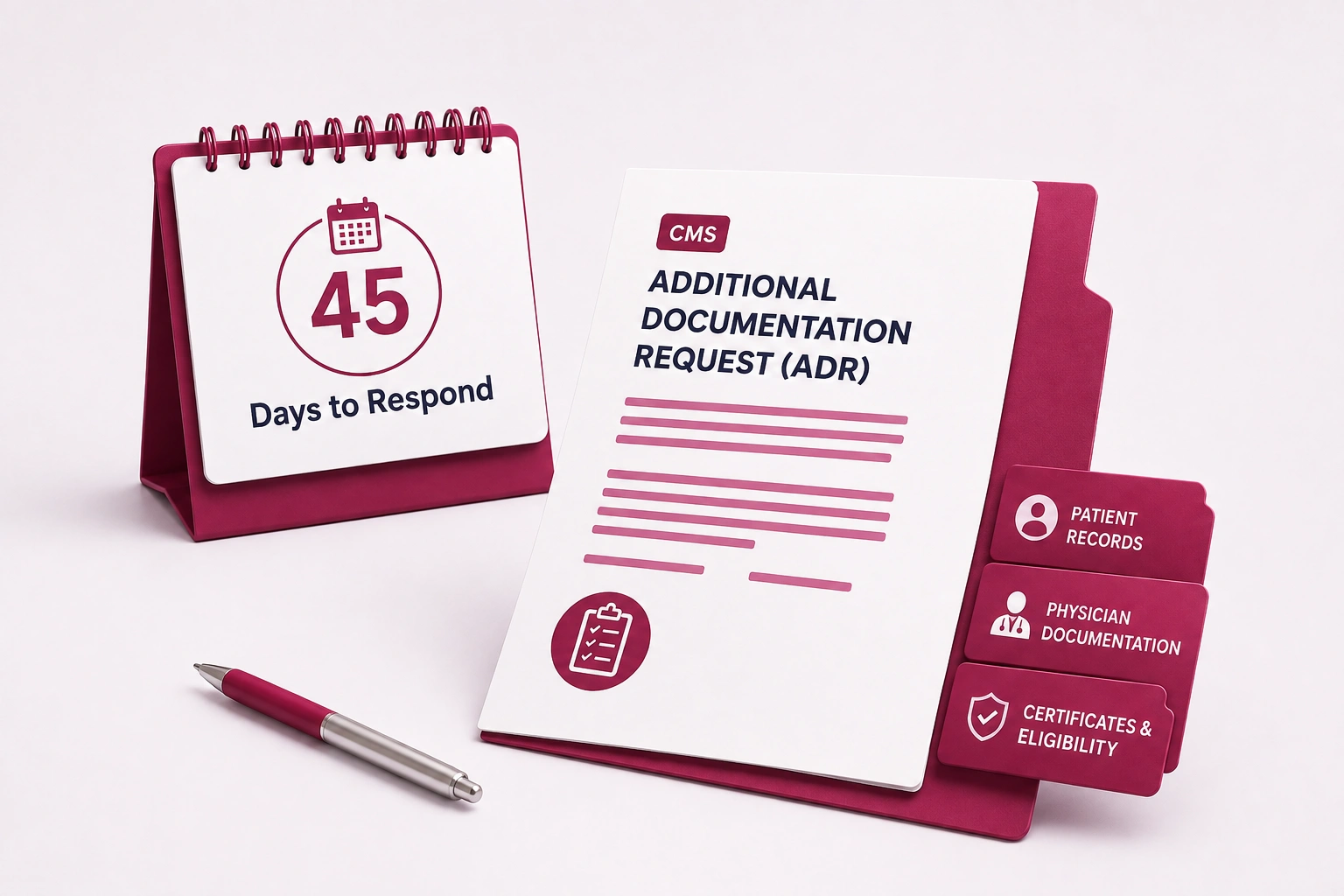

An Additional Documentation Request (ADR) is a formal written request from a Medicare contractor asking a provider to submit clinical records supporting a billed claim. Response timelines are fixed by federal regulation and differ by contractor type. Under 42 CFR Section 405.903, providers have 45 calendar days to respond to a Medicare Administrative Contractor (MAC), Recovery Audit Contractor (RAC), or Supplemental Medical Review Contractor (SMRC) request. A Unified Program Integrity Contractor (UPIC) request compresses that window to 30 calendar days, as confirmed by the Centers for Medicare and Medicaid Services (CMS)
(CMS Medicare Program Integrity Manual,Chapter 3). If no response is received within the applicable window, the contractor denies the claim without reviewing the medical record.
For home health and hospice agencies, an ADR is the point at which every prior documentation and coding decision on a claim is tested against Medicare coverage criteria, by a reviewer who has no other context on the patient, not just an isolated administrative task. Agencies without a structured ADR response protocol in place before a request arrives consistently take longer to assemble a complete package and generate a higher share of unfavorable determinations than agencies with a documented, repeatable process.
This guide covers what triggers an ADR, the response timelines and requirements by contractor type, how to build a complete response package for home health and hospice claims, and what happens after a determination is issued.
For the broader Medicare audit landscape covering TPE, RAC, UPIC, and CERT activity, refer to the Home Health Medicare Audit Defense and Compliance Guide for 2026.
Key Takeaways
- ADR response timelines are fixed by regulation, not by contractor discretion. Providers have 45 calendar days to respond to a MAC, RAC, or SMRC request under 42 CFR Section 405.903, and 30 calendar days for a UPIC request. Missing the deadline results in automatic claim denial without medical record review.
- The clock starts on the date printed on the ADR letter, not the date the letter is opened or the date staff begin assembling the response. Agencies that log ADRs only after someone reads the letter lose response time they cannot recover.
- Insufficient documentation, not medical necessity or incorrect coding, is the leading cause of hospice improper payments. Missing physician narrative explaining the six-month prognosis is a specific, recurring finding in Medicare medical review.
- The FY 2026 Hospice Wage Index and Payment Rate Update Final Rule (CMS-1835-F), effective October 1, 2025, clarified that the hospice face-to-face encounter attestation must include the practitioner's signature and date. A signed, dated clinical note documenting the encounter satisfies this requirement.
- A response package organized to mirror how the reviewer evaluates the claim, certification and eligibility documentation first, followed by supporting clinical evidence, reduces the likelihood the reviewer must search for information that was submitted but not easy to locate.
- Every ADR outcome, favorable or unfavorable, is a data point. A pattern of ADRs concentrated in a specific diagnosis category, clinician, or documentation type indicates a systemic gap that a single response will not resolve.
What Triggers a Medicare ADR
ADRs are issued by several different Medicare entities, each with a different review purpose and authority. Understanding which entity issued the request shapes how the response should be organized and what level of scrutiny to expect.
MACs select most ADR candidates through data-driven analysis rather than random sampling. Billing patterns that deviate from peer benchmarks, including denial rates above the jurisdiction average or unusual length-of-stay distributions, increase the likelihood of selection. A UPIC request follows a different pattern: it typically originates from a data anomaly across multiple claims or patients rather than a single claim-level trigger, and it signals a more serious level of program integrity concern than a routine MAC probe. RACs and SMRCs generally review claims already processed and paid, focusing on identifying overpayments, underpayments, or compliance with a CMS-directed project scope rather than the real-time claim edits that trigger a MAC prepayment ADR.
ADR Response Timeline Mechanics
The response window begins on the date printed on the ADR letter. Agencies that calculate the deadline from the date the letter is opened or logged, rather than the date printed on the letter, are working from an inaccurate start date and may submit a technically late response without realizing it.
Immediate Steps Upon Receipt
- Log the ADR with the exact date printed on the letter, the claim number, the requested documentation, and the calculated due date. Do not use the date of internal receipt or the date staff began working on the response.
- Assign a single point of accountability, typically the compliance officer or billing manager, for assembling the complete record. Distributing the task informally across clinical and billing staff without one person tracking completion increases the risk that a required document is missed.
- Confirm which entity issued the request and the applicable response window (45 days for MAC, RAC, or SMRC; 30 days for UPIC) before building the response timeline.
Escalation Level: Immediate: Every ADR must be logged with its due date within 24 hours of receipt. A late response is treated the same as no response, resulting in automatic denial regardless of documentation quality.
Good Cause Extensions
Contractors may accept documentation received after the 45-day or 30-day window for good cause, defined narrowly to include circumstances such as natural disasters or interruptions in business operations (CMS Medicare Program Integrity Manual, Chapter 3). Good cause exceptions are not routinely granted and should not be relied upon as a substitute for meeting the standard deadline.
Building the ADR Response Package for Home Health Claims
Home health ADR responses should be organized to mirror how the reviewer evaluates the claim. A response that requires the reviewer to search for supporting documentation increases the likelihood of an unfavorable determination.
Required Documentation, in Review Order
- Physician certification and face-to-face encounter documentation establishing homebound status and eligibility at Start of Care.
- The plan of care, signed and dated, reflecting the services ordered and provided.
- Outcome and Assessment Information Set (OASIS) assessment for the episode, with functional scoring supported by the visit narrative.
- Visit notes for the billing period establishing medical necessity for each service billed, connecting the documented task to the patient's condition and the physician's orders.
- Billing documentation confirming the codes submitted align with the clinical record and the OASIS assessment.
Red Road Insight: The home health ADR responses that resolve fastest are organized so the reviewer can trace eligibility, medical necessity, and billing accuracy in the same sequence they evaluate the claim, rather than relying on documentation volume alone.
Building the ADR Response Package for Hospice Claims
Hospice ADR responses carry additional documentation requirements specific to establishing and re-establishing terminal prognosis at each certification period.
Required Documentation, in Review Order
- Certification of Terminal Illness (CTI), signed and dated by the hospice physician and, where required, the attending physician, for the benefit period in question.
- Physician narrative explaining the clinical findings supporting a life expectancy of six months or less. A CTI missing this narrative is treated as an insufficient documentation error and the claim is recouped.
- Face-to-face encounter attestation for the applicable benefit period, including the practitioner's signature and date. Under the FY 2026 Hospice Final Rule, a signed and dated clinical note documenting the encounter satisfies this requirement without a separate standalone attestation form.
- Interdisciplinary Group (IDG) documentation and updated plan of care reflecting the patient's current clinical and psychosocial status.
- Physician progress notes and, where relevant, ancillary staff documentation (nursing, social work, chaplaincy) supporting the terminal prognosis and level of care billed.
The FY 2026 Hospice Wage Index and Payment Rate Update Final Rule (CMS-1835-F), effective October 1, 2025, confirmed that the face-to-face attestation must include the practitioner's signature and date, but allows that requirement to be satisfied by a clearly titled section, an addendum, or a signed and dated clinical note documenting the encounter (CMS FY 2026 Hospice Final Rule Fact Sheet). Agencies preparing an ADR response should confirm the attestation, wherever it is documented, meets this standard before submission.
Escalation Level: Short-term : Agencies preparing a hospice ADR response for a non-cancer terminal diagnosis should confirm disease-specific staging documentation (FAST scale for dementia, NYHA classification for cardiac conditions) is present and current for the certification period in question before submitting.
Common ADR Denial Reasons and How They Are Identified
Insufficient documentation is the leading cause of improper payments for both hospital-based and non-hospital-based hospice services, and a consistent driver of home health denials as well. According to CMS compliance data, insufficient documentation accounted for 82.8% of hospital-based and 63% of non-hospital-based hospice improper payment findings, with medical necessity and incorrect coding as secondary causes (CMS Hospice Services Compliance Tips).
Recurring Findings in ADR Reviews
- Missing physician narrative on the Certification of Terminal Illness. The narrative must explain the clinical findings supporting the six-month prognosis; a signed certification without the narrative is an insufficient documentation error, not merely an administrative gap.
- Face-to-face encounter documentation missing the practitioner's signature and date, or completed outside the required timeframe relative to the certification period.
- Visit notes that do not connect the documented task to medical necessity, describing what was done without explaining why it was required.
- Recertification documentation that restates the initial certification findings rather than demonstrating continued decline against the applicable clinical criteria.
Red Road Insight: The gap between a favorable and unfavorable ADR determination is about whether the documentation submitted allows a reviewer with no other context to independently confirm the criteria were met, more than whether care was actually provided. A narrative that says the patient is declining is not sufficient. A narrative that documents the specific functional or clinical change during the certification period is.
What Happens After You Submit a Response
Once the response is received, the contractor reviews the documentation against Medicare coverage criteria and issues a determination. A favorable determination confirms the claim as submitted. An unfavorable determination results in denial, in full or in part, and the provider has appeal rights.
If the Determination Is Unfavorable
Providers should request redetermination through the standard Medicare appeals process within the applicable deadline rather than treating the initial determination as final. The appeals process involves multiple levels, beginning with redetermination by the same contractor and escalating to an independent review if the outcome is not favorable.
Tracking Patterns Across ADR Outcomes
Every ADR outcome should be logged and categorized by denial reason, diagnosis category, clinician, and issuing contractor. A pattern of ADRs concentrated in a specific diagnosis category or documentation type indicates a systemic gap that a single successful appeal will not resolve. Agencies should review ADR outcomes alongside broader compliance data, including PEPPER percentile rankings, to determine whether an ADR pattern reflects a documentation training need or a workflow gap.
For agencies managing non-cancer hospice terminal diagnoses, where ADR findings frequently concentrate around disease-specific staging documentation, the ICD Coding for Non-Cancer Terminal Diagnoses guide covers the LCD-specific clinical thresholds and coding patterns that most directly affect hospice ADR outcomes.
Escalation Level: Monthly : ADR volume, denial reasons, and outcomes should be reviewed monthly by diagnosis category and issuing contractor. A rising concentration in one category should trigger a targeted documentation review before the next certification cycle.
Building an ADR-Ready Documentation Workflow
Agencies that respond well to ADRs have a documented workflow that runs the same way every time an ADR arrives, independent of who is available to work on it, more than they have the most experienced compliance staff.
Minimum Workflow Elements
- A standing ADR log tracking issuing entity, receipt date, due date, requested documentation, and current status for every open request.
- A single assigned point of contact per ADR, responsible for assembling the complete record and confirming submission before the deadline.
- A documentation checklist specific to home health and hospice claim types, reflecting the required elements in review order, not just a list of document names.
- A final review step confirming every requested item is included and legible before the package is submitted, with the ADR letter attached on top for the reviewer's reference.
Red Road Insight: Agencies that treat ADR response as a workflow rather than a one-off scramble consistently submit faster and more complete packages. The difference comes down to whether the checklist, the point of contact, and the final review step exist before the first ADR letter arrives.
For agencies where coding accuracy issues are a recurring driver of ADR activity, addressing the underlying documentation gap is more effective than repeatedly building strong responses to the same root cause. The 7 Home Health Coding Errors guide covers the specific coding patterns that most frequently generate ADR and denial activity.
How External Documentation Review Supports ADR Readiness
For agencies managing ADR volume across multiple clinicians, diagnosis categories, and contractor types, building a compliant response package under a 30- or 45-day deadline while continuing normal clinical operations is a capacity challenge, not a knowledge gap. An external documentation review function operating as both a pre-submission checkpoint and an ADR response resource reduces the risk of an incomplete or late submission.
For home health and hospice ADR response specifically, this includes assembling the complete record against the specific request, confirming coded responses align with narrative documentation, verifying physician narrative and face-to-face attestation completeness before submission, and tracking response deadlines across every open request.
The Bottom Line
A Medicare ADR is a compliance test conducted under a fixed and non-negotiable deadline, 45 calendar days for a MAC, RAC, or SMRC request, 30 for a UPIC request, against documentation standards that assume no prior context on the patient, more than a documentation exercise. Agencies that build a repeatable ADR response workflow before a request arrives consistently submit more complete records and generate fewer unfavorable determinations.
The strongest ADR response depends on whether the documentation submitted allows an unfamiliar reviewer to independently confirm that Medicare coverage criteria were met, in the order the reviewer evaluates the claim, not on the volume of documentation submitted.
How Red Road Supports Medicare ADR Response
Red Road's clinical documentation review service provides Registered Nurse clinical reviewers who assemble ADR response packages against the specific documentation requested, verify that coded responses align with narrative clinical documentation, and confirm physician certification, narrative, and face-to-face attestation completeness before submission. This reduces the risk of an incomplete package and supports a higher resolution rate on first response.
ADR outcomes, denial reasons, and response timelines are tracked and reported monthly, allowing agencies to identify whether ADR activity is concentrated in a specific diagnosis category, clinician, or documentation type and address the underlying cause rather than responding to each request in isolation.

.svg)
.webp)