%201.svg)
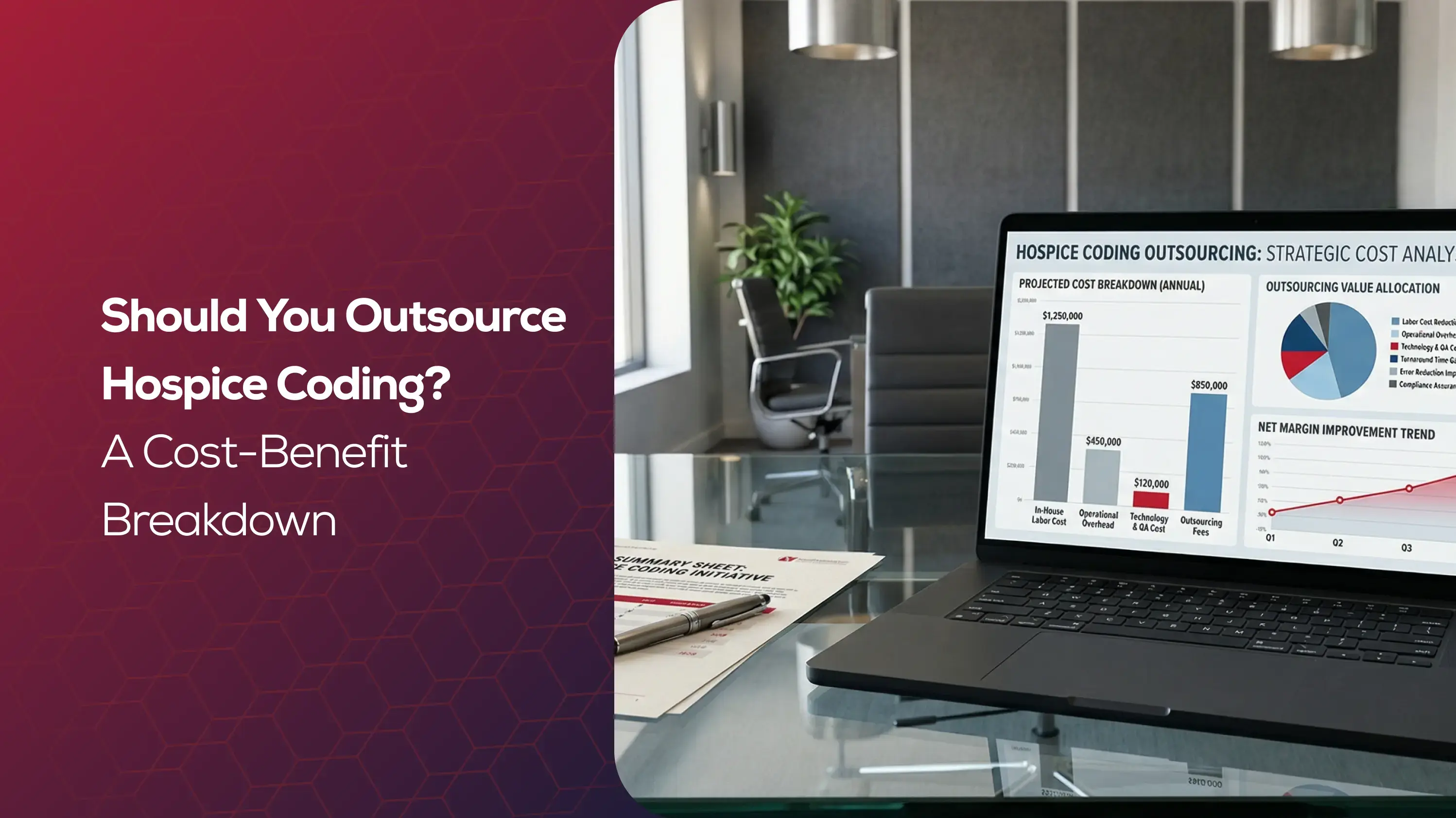

Hospice coding has grown into a strange intersection of clinical interpretation, financial consequence, and the kind of judgment that resists automation. Every diagnosis choice and sequencing decision ties back to eligibility strength and audit survival. With HOPE-driven reporting reshaping documentation and CMS sharpening its expectations, agencies are rethinking whether coding should remain entirely in-house or whether outsourcing now offers more stability and control.
Outsourcing looks like a simple operational shift, but it changes how an agency experiences cash flow, risk exposure, and clinical alignment. The question is no longer “should we outsource” but “is our current structure supporting the financial and clinical performance we need.”
The Real Cost of Keeping Medical Coding Services In-House
Internal teams feel familiar and accessible. Yet comfort sometimes conceals structural tension.
Staffing Volatility and Talent Gaps
Experienced hospice coders blend clinical literacy with payer awareness. Finding someone with that mix is difficult. Keeping them is harder. A single resignation can create weeks of backlog. Recruitment takes time. Training takes more. Claims wait in quiet stacks while leadership waits for movement that feels perpetually out of reach.
Variable Throughput During Census Changes
Hospice census behaves unpredictably. Some months overwhelm the coding team with rapid documentation influx. Others fall silent. A fixed internal workforce synced to a variable census makes resource planning almost impossible.
Increasing Compliance Pressure
Regulatory expectations move quickly. The CMS Medicare Learning Network updates guidance.
LCD criteria shift.
The OIG Hospice Review Reports highlight recurring vulnerabilities.
Internal teams often struggle to stay current while meeting daily deadlines. The gap between documentation and CMS expectations becomes the birthplace of denials.
Limited QA Capacity
Single-layer review magnifies risk. When one coder handles documentation, sequencing, and review, patterns of error can repeat quietly. A missing symptom rationale. A decline pattern that never fully connects. A narrative that reads well but collapses under payer scrutiny.
Where Outsourced Medical Coding Services Create Advantage
When hospice agencies outsource to a specialized coding partner, the workflow expands rather than shifts.
Scalability That Smooths Census Volatility
Outsourced teams absorb spikes effortlessly. Claims keep moving during months when internal teams would normally be overwhelmed. During quiet months, agencies do not pay for unused capacity.
Consistent Interpretation With Structured Frameworks
Specialized medical coding services bring sequencing models, dual-review systems, and clinical alignment practices that reduce variation. Consistency equals defensibility.
Faster Coding-to-Billing Timelines
Claims move faster when the coding function no longer bottlenecks. Reimbursement stabilizes. AR days settle into predictable patterns.
Compliance Immersion at All Times
External teams maintain continuous exposure to:
- CMS MLN
- CMS Program Integrity Manual
- NAHC
- OIG hospice audits
This keeps claims aligned with national standards.
Reduction in Avoidable Denials
Eligibility inconsistencies, sequencing misalignment, and documentation gaps surface early, long before claims hit payer review.
Where Outsourcing Medical Billing and Coding Services Shows Limitations
Outsourcing improves structure, but agencies must be aware of the inherent trade-offs.
Less Immediate Clinical Context
External coders interpret what is written. They are not in care meetings and cannot intuit details missing from documentation.
Dependence on Vendor Timelines
If the partner’s workflow slows, the entire revenue cycle feels it. Agencies need partners who maintain steady turnaround.
Variation in Industry Expertise
Some vendors operate generically across healthcare. Hospice requires clinical nuance that not all medical coding service providers can deliver.
Limited Clinical Validation
Hospice eligibility is built on a clinical story. Without clinician review layered on top of coding accuracy, complex cases become vulnerable during audit.
Hybrid Models: Where Internal and Outsourced Coding Work Together
Most high-performing agencies now use hybrid workflows. Internal coders preserve clinical context. External teams add capacity, dual reviews, audit support, and sequencing consistency. When documentation visibility is shared across both sides, the workflow becomes cohesive rather than siloed.
Cost-Benefit Breakdown of Outsourced Medical Coding Services
Direct Savings
- Lower staffing expenses
- Reduced recruitment and onboarding cost
- Less overtime during volume spikes
- Fewer productivity declines during transitions
Indirect Savings
- Fewer denials
- Less rework
- Documentation that survives payer scrutiny
- Better outcomes during probe reviews
Strategic Advantages
- More predictable cash flow
- Stronger forecasting
- Reduced burnout
- Higher QA consistency across the board
When Hospice Agencies Should Consider Outsourced Medical Coding Services
Signals appear long before a system breaks. Outsourcing becomes necessary when:
- Census swings regularly create backlog
- Denials increase unexpectedly
- Documentation lacks alignment with eligibility criteria
- Compliance updates fall behind
- QA capacity feels thin
- Medical necessity narratives feel shallow
- Cash flow becomes unpredictable
If several of these appear together, the need becomes urgent.
How Red Road’s Medical Coding Services Strengthen RCM
Red Road enhances internal teams rather than replacing them. Our focus is on clearer interpretation, stronger sequencing, and better documentation alignment to reduce financial and compliance risk.
Our approach includes:
- Dual-layer review by credentialed professionals
- Sequencing practices aligned with CMS hospice expectations
- Clinical documentation review
- Transparent workflow collaboration with internal teams
- Audit and ADR support
- Scalable coverage for census shifts
- Turnaround times that stabilize reimbursement
Red Road positions medical coding services and medical billing and coding services as operational accelerators, not outsourcing vendors.
The Road Ahead for Hospice Providers
Outsourcing hospice coding is no longer a simple operational adjustment. It is a strategic decision tied to risk, financial stability, and accurate clinical storytelling. Agencies that blend internal knowledge with external medical coding services build revenue cycles that are stronger, calmer, and better aligned with CMS expectations. In an environment where precision matters more than ever, outsourced medical billing and coding services become a long-term investment rather than a stopgap solution.

.svg)